Industrial Automation Synergy

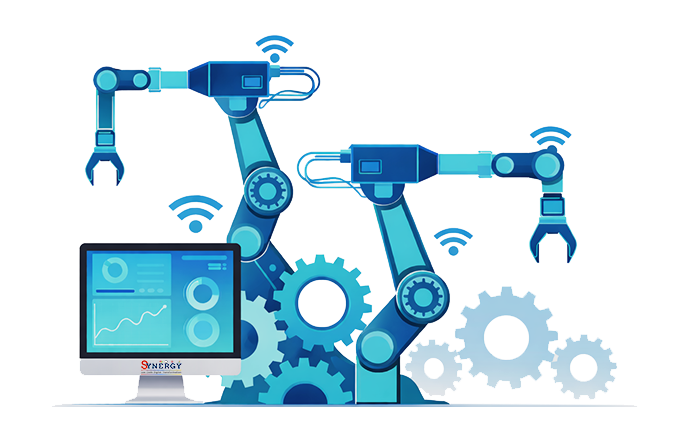
Synergy enables end-to-end digitalization and automation of industrial operations through a single platform integrating workflows, machine data, IoT, routing, quality, approvals, and packaging.

Industrial Operations Digitalization, Automation, and Optimization Platform

Synergy empowers organizations to digitize, automate, and optimize industrial operations by providing a unified, enterprise-grade platform that orchestrates end-to-end shop floor execution. By integrating production workflows, machine data, IoT inputs, job routing, quality tracking, approval workflows, and packaging operations, Synergy transforms traditional manufacturing environments into connected, intelligent, and highly efficient operations.

The platform is designed to seamlessly integrate with ERP, MIS, and other enterprise systems, consolidating operational and transactional data into a centralized execution and analytics layer, enabling faster, smarter, and error-free manufacturing.

Key Features

The Synergy Platform Architecture is designed as a scalable, modular and secure framework that supports high-performance industrial and enterprise applications. It follows a multi-layered architecture to ensure flexibility, interoperability, and resilience across complex operational environments.

Real-Time Visibility

Automated Production Workflows

Smart Packaging & Dispatch Management

Predictive Insights & Alerts

Low-Code Flexibility

Enterprise-Grade Integration

Key Technical Capabilities

Production Workflow Orchestration

  • Design, model, and execute end-to-end production workflows.
  • Support for sequential, parallel, and conditional task execution.
  • Real-time workflow monitoring and exception handling.
  • Dynamic adjustment of workflows based on production priorities and resource availability.

Real-Time Machine & IoT Data Integration

  • Collection of telemetry from PLCs, sensors, and IoT-enabled devices.
  • Standardized data ingestion via gateways.
  • Support for real-time streaming analytics and alerting.
  • Predictive maintenance insights based on machine data patterns.

Job Routing and Scheduling

  • Dynamic routing of jobs across machines, production lines, or plants.
  • Integration with ERP/MIS for production order synchronization.
  • Automated prioritization based on deadlines, resources, and material availability.
  • Real-time rescheduling to minimize downtime and maximize throughput.

Quality Management & Tracking

  • In-process inspection and defect tracking at every stage of production.
  • Automated quality checkpoints and rule-based validation.
  • Traceability of raw materials, work-in-progress, and finished goods.

Approval & Exception Workflows

  • Digital approval flows for operational deviations, overrides, and production exceptions.
  • Role-based access control for decision-making authority.
  • Automated escalation for unresolved or critical exceptions.
  • Audit trails and compliance reporting for regulatory adherence.

Packaging & Post-Production Operations

  • Coordination of packaging, labeling, and material handling processes.
  • Integration with automated packaging lines and conveyors.
  • Real-time status monitoring and reporting.
  • Optimization of packaging sequences based on production output and demand.

Enterprise Integration

  • Bi-directional integration with ERP, MIS, PLM, WMS, and SCM systems.
  • Secure API-based connectivity and event-driven messaging.
  • Synchronization of master data, bills of materials, production orders, and inventory levels.
  • Centralized data repository for operational intelligence and reporting.

Data Consolidation & Analytics

  • Aggregation of operational, machine, and transactional data into a unified analytics layer.
  • Support for structured and unstructured data processing.
  • Real-time dashboards and KPI monitoring.
  • Advanced analytics including predictive modeling, anomaly detection, and performance optimization.

Shop Floor Execution & Control

  • Real-time visibility of production progress and bottlenecks.
  • Rule-based automation for decision-making and exception handling.
  • Automated notifications, alerts, and task assignments.
  • Integration with SCADA/MES for deterministic and synchronized execution.

Security, Governance & Compliance

  • Role-based access control and multi-factor authentication.
  • Data encryption at rest and in transit.
  • Compliance with industry standards (ISO, FDA, GMP, etc.).
  • Full audit trail and historical traceability for regulatory inspections.

Scalability & Architecture

  • Modular, microservices-based platform supporting multi-plant deployment.
  • Cloud-native or on-premises deployment options.
  • Horizontal scaling for high-volume operations.
  • Edge computing support for latency-sensitive processes.

Advanced Features & Future-Ready Capabilities

  • AI-driven predictive maintenance and process optimization.
  • Integration with digital twins for simulation and scenario modeling.
  • Low-code/no-code interface for rapid workflow changes.
  • Support for continuous improvement initiatives (Lean, Six Sigma).

Benefits of Synergy Platform for Industrial Automation

Synergy - A Low-Code IT platform for Industrial Automation empowers organizations to accelerate digital transformation, reduce costs, enhance operational agility, and enable real-time visibility, all while supporting seamless integration with existing industrial systems and future-ready smart manufacturing initiatives.

Accelerated Development & Deployment
  • Rapid creation of applications, dashboards, and workflows without extensive coding.
  • Reduced time-to-market for automation solutions, enabling faster response to operational changes.
  • Drag-and-drop interface for designing shop floor processes, IoT integrations, and reporting tools.
Enhanced Agility & Flexibility
  • Easy modification of workflows and processes to meet evolving production requirements.
  • Quick adaptation to new machinery, IoT devices, or regulatory changes.
  • Supports iterative improvement and continuous process optimization.
Seamless Integration with Existing Systems
  • Connects to ERP, MES, SCADA, PLCs, IoT platforms, and legacy systems through connectors.
  • Enables data consolidation across multiple sources for real-time decision-making.
  • Facilitates bi-directional communication with industrial and enterprise systems.
Reduced IT & Operational Costs
  • Lower development and maintenance costs compared to traditional coding.
  • Minimizes reliance on specialized software engineers for automation applications.
  • Consolidates multiple standalone applications into a single, manageable platform.
Empowerment of Business & Operations Teams
  • Enables engineers, operators, and business users to create or modify applications with minimal coding knowledge.
  • Reduces dependency on IT for small process improvements or reporting needs.
  • Encourages collaboration between IT and operations for faster solution delivery.
Faster Prototyping and Proof-of-Concepts
  • Quickly build and test automation applications or process improvements.
  • Validate production ideas or process changes without long development cycles.
  • Supports iterative feedback from shop floor teams to refine workflows.
Improved Operational Visibility & Analytics
  • Real-time dashboards, alerts, and KPIs can be developed quickly.
  • Enables predictive and prescriptive analytics for process optimization.
  • Provides actionable insights without extensive coding or manual reporting.
Enhanced Compliance and Governance
  • Built-in process controls, approval workflows, and audit trails.
  • Supports regulatory compliance (ISO, FDA, GMP) with standardized processes.
  • Ensures traceability of process changes and data for reporting and audits.
Scalability and Future-Readiness
  • Modular architecture allows applications to scale across lines, plants, or geographies.
  • Supports integration of AI, machine learning, and Industry 4.0 initiatives.
  • Prepares industrial operations for smart factories and digital transformation.
Risk Reduction
  • Minimizes errors in application development through visual modeling and validation.
  • Reduces downtime caused by misconfigured workflows or manual processes.
  • Enables controlled deployment of changes with testing and rollback capabilities.

Resources

Find Out More about Our Expertise & Strengths

DataSheet
Download Now